The effects of class size in online college courses: Experimental evidence
GAICIL Insights
Few beliefs in education are as sacred as small classes.1 The effects of class size in online college courses: Experimental evidence, by Eric Bettinger, Christopher Doss, Susanna Loeb, Aaron Rogers and Eric Taylor, tests whether the belief survives the move online. Class size is a first-order consideration in the cost and effectiveness of education. In a field experiment at DeVry University, one of the largest for-profit postsecondary institutions in the country, students were quasi-randomly assigned to regular classes averaging 31 students or to classes about ten percent larger. The experiment covered over 100,000 student course enrollments in nearly 4,000 classes across 111 undergraduate and graduate courses.
The answer is a confident shrug. There is little evidence of effects on average or for a range of course types. Increasing class size by ten percent does not significantly affect grades, enrollment in the next term or credits attempted the next term. Thanks to the large sample, the estimates are precise, and the authors can confidently rule out effect sizes similar to those in prior literature for K-12 and higher education. A precise zero is a finding, and a valuable one.
The test was a hard one. DeVry did not aim to create MOOCs, which have average completion rates of about 7 percent. It aimed to recreate the traditional classroom over the internet, preserving interaction among students and between students and faculty. Students must post and respond to others, and professors actively engage in online conversations. If class size mattered online, it would matter here, where disruptive or congestive effects of the kind predicted by Lazear's model are possible.
The mechanism is intuitive once stated. Interactions appear muted enough in virtual classrooms to absorb financially relevant changes in class size without degrading outcomes. It is harder for students to distract each other during lectures, and they have more flexibility in reading peer posts than in listening to peer discussion. Even in classes with projects and laboratories, where peer interactions would plausibly matter more, the change had no detectable effect. Online classes may also have reduced professor-student interactions, or made them more efficient. The virtual classroom has no back row to misbehave in.
For the economics of artificial intelligence in education, this is a capacity story. Online formats appear to scale without the congestion costs that limit physical classrooms. AI tools could extend this property, handling routine questions, feedback and grading so instructors can serve larger classes while preserving the interactions that matter. Modest increases in online class size need not harm students, which supports using technology to expand capacity.
The null result is also a budget tool. If small increases in class size have little impact online, institutions can reallocate savings toward interventions with larger effects, such as advising or targeted support for struggling students. AI could help identify where such support yields the greatest returns. The authors' precise null is valuable because it frees resources for better uses. Money spent defending a class-size ratio that does not matter is money withheld from students who need help.
Extrapolation needs discipline. The experiment varied class size by about ten percent around a mean of roughly 30 students. Larger changes might produce different effects, and the results apply to classes designed to preserve interaction. AI-enabled scaling that pushes class sizes far beyond this range needs its own evaluation, and large-scale experimentation within an institution shows how to run it.
For policy, the study supports flexibility. Regulations or accreditation standards that fix online class sizes based on assumptions drawn from physical classrooms may be unnecessarily restrictive. Evidence from online settings should guide such rules, and experiments can determine appropriate class sizes, letting technology expand access at lower cost without sacrificing quality.
Distilled to one claim: the economics of online education differ from those of physical classrooms. Congestion appears weaker, and capacity can grow at modest cost to outcomes. As AI transforms teaching, these differences may widen. Experimental evidence of this kind is essential for systems that expand access while protecting learning.
One question to put to accreditors: retire rules that import physical-classroom ratios into virtual ones, and demand experiments in their place. Rules built for lecture halls may be rationing seats that online students could have filled at no cost to learning.
Introduction
Class size is a first-order consideration in the study of education cost and effectiveness. Yet little is known about the effects of class size on student outcomes in online college classes, even though online courses have become commonplace in many institutions of higher education. We study a field experiment in which college students were quasi-randomly assigned to either regular sized classes or slightly larger classes. Regular classes had, on average, 31 students and treatment classes were, on average, ten percent larger. The experiment was conducted at DeVry University, one of the nation's largest for-profit postsecondary institutions, and included over 100,000 student course enrollments in nearly 4,000 classes across 111 different undergraduate and graduate courses. We examine class size effects on student success in the course and subsequent persistence in college. We find little evidence of effects on average or for a range of course types. Given the large sample, our estimates are precise, suggesting that small class size changes have little impact in online settings.
Takeaway
In this paper we present evidence of the effect of online class size on a variety of student outcomes. For online classes with an average of 30 students, increasing the class size ten percent does not significantly affect student grades, enrollment in the next term, or credits attempted the next term. We can confidently rule out effect sizes similar to the prior literature in both K-12 and in higher education. At first one may find these results unsurprising. Some may argue that online classes are meant to make education accessible to more people by removing physical barriers and reducing the dependence on communication with the professor and peers. The increased temporal and physical flexibility comes at the cost of interacting as closely with others. In this view the mechanisms posited by Lazear by which class size could affect student outcomes would be muted, allowing classes to grow without changing the quality of the product. Indeed this mechanism is the hope behind MOOCs. The goal for DeVry, however, was not to create MOOCs which have average completion rates of about 7 percent (Jordan 2014), but rather to recreate the traditional classroom delivered over the internet.2 These online classes are meant to provide temporal and physical flexibility for the students, while preserving the interaction among Page 22 of 44 students and between students and faculty.1
Students are required to post and respond to other posts, while professors actively engage in online conversations. If class size could affect online performance, it would be in these types of classes where disruptive or congestive effects as predicted in Lazear’s model are possible (see Bettinger, Loeb and Taylor 2015). As it turns out, these interactions may be muted enough in virtual classrooms to accommodate financially relevant changes in class size without degrading outcomes for students. Even in this context it is more difficult for students to distract each other while the professor is lecturing, and students have more flexibility in reading peer posts than in listening to peer discussion during the class. Even in classes where peer-to-peer interactions would be plausibly more important, such as classes that include projects and laboratories, students surprisingly are not affected by the ten percent change in class size. The online classes may have reduced professor-student interactions, or made them more efficient, such that increasing class sizes may not necessarily reduce professor availability. For example professors may be able to answer all questions and to respond to all posts, whether there are 30 or 33 students in the class. These results have policy and financial implications. Virtual classrooms have the advantage of making courses more widely available to students who have difficulty with the location or timing of in-person classrooms.
Prospective students who live too far from a university, or whose schedules do not fit with traditional school schedules, can use online classes to access previously unavailable content. Virtual courses also do not have physical plant limitations that can limit the number of people who can enroll in a course at a time. Thus, schools can respond to changes in demand more quickly in the online setting. As long as the institution can preserve the quality of the product, online courses have the potential to broaden Page 23 of 44 access to higher education. This study gives the first evidence that small but meaningful increases in class sizes in the online context may not degrade the quality of the class. As we stated earlier, DeVry offers two-thirds of its courses online. They can dramatically increase the access to their offerings simply by adding two to five students to each of their thousands of online sections. If these results are generalizable to other for-profit institutions with a large online presence, such as the University of Phoenix, these already large gains in access to higher education can be amplified even further. The sheer number of online sections means that small increases in class sizes can result in large increases in aggregate enrollment – all plausibly with little or no reduction in student outcomes.
These results also have financial implications for universities and students. A 10 percent increase in class size is equivalent, in most all cases, to a 10 percent reduction in the number of course sections DeVry must offer and staff with a professor. The associated cost savings would come primarily from professor compensation; the marginal cost of adding a section is negligible. Assuming the section wage rate is constant for the class size increases in this range, and assuming that enrollment is not a function of class size, a 10 percent class size increase would save the university 10 percent in salary expenses. DeVry could use the cost saving to improve the quality of classes in other ways through higher wages for professors or greater investments in curriculum and instruction.
Notes
- Eric Bettinger et al., The effects of class size in online college courses: Experimental evidence, 58 Econ. Educ. Rev. 68 (2017), https://doi.org/10.1016/j.econedurev.2017.03.006. Takeaway source: 7. Conclusions and Policy Implications, reproduced from a free author or repository copy (working-paper version). ↩
- Jordan, K. (2014). Initial trends in enrolment and completion of massive open online courses. The International Review of Research in Open and Distributed Learning, 15(1).. ↩
Cite as: Eric Bettinger et al., The effects of class size in online college courses: Experimental evidence, 58 Econ. Educ. Rev. 68 (2017), https://doi.org/10.1016/j.econedurev.2017.03.006
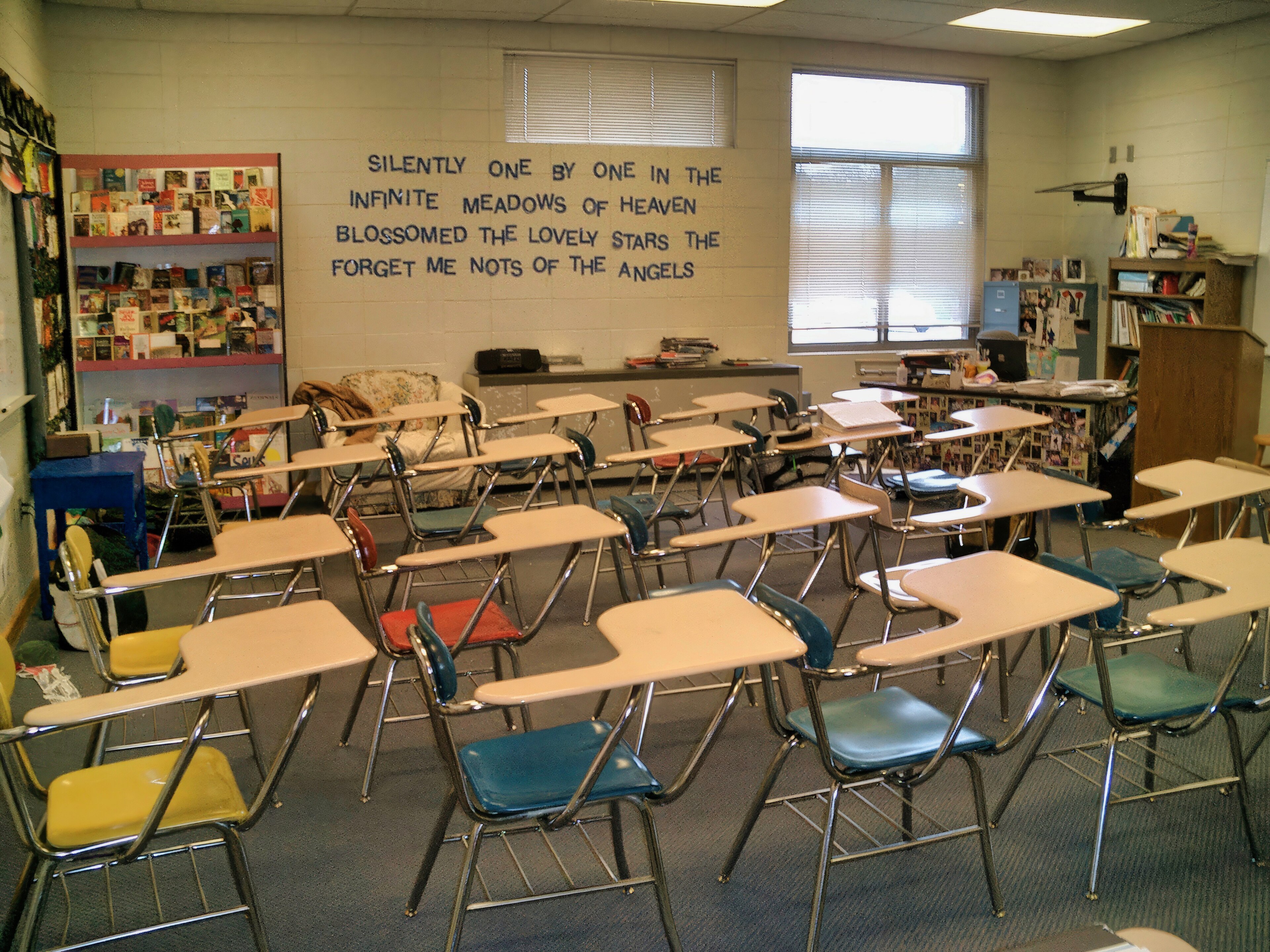
Header image: A Hayesville High School classroom in Clay County, N.C., in 2004.jpg by Harrison Keely, CC BY 4.0, via Wikimedia Commons.

